Using AI in tabletop game design without sacrificing creativity
People are wary of using AI in game design for understandable reasons. We don’t want to lose the human artistry and expression which goes into games. But are there ways that AI can help us, without sacrificing the creative side of things?
In the recent Pro version of the Card Game Builder app, we added MCP support.
MCP stands for Model Context Protocol, which is a way for an AI agent to communicate with another application (in this case Card Game Builder).
We can then ask the AI questions about a game, and to perform edits if required.
I’ve been playing around with this, to see how AI can be helpful without removing the joy of creating games.
What useful things can AI do for us?
Checking for typos
An example of a very simple task that AI can do is looking for typos in the rules, and on the cards.
A person is still writing the rules - the AI is just checking for errors.
Nobody likes a game which ships with spelling errors.
Balancing a game
Balancing a game can be really hard.
Some games follow quite simple mathematical rules. Magic: The Gathering was a bit like this in the early days. Take this Grizzly Bears card as an example:
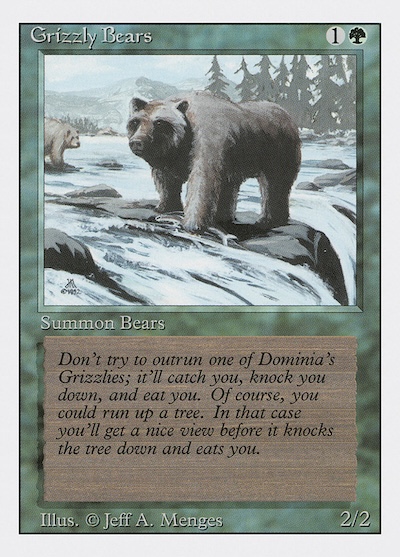
There was a rough relationship between the mana cost and power/toughness of creatures:
| Mana Cost | Power | Toughness |
|---|---|---|
| 1 | 1 | 1 |
| 2 | 2 | 2 |
| 3 | 3 | 3 |
Note - this is an approximation. There are so many Magic: The Gathering cards, and many break these rules.
But when you start throwing in keywords like first strike, and flying - how should that impact the mana cost?
This is where playtesting comes in. By playing lots of games with these cards, we can work out if the mana costs are fair.
Nothing replaces proper playtesting, but an AI can run hundreds, or even thousands, of quick simulations to identify cards which are clearly broken. This saves us time, so playtesting is more about making things fun.
When I asked Claude to do this for one of my games, it generated a Python script which contained a scoring methodology for the cards. Using our simplified Magic: The Gathering example from above, we could do something like this:
| Keyword | Mana Cost |
|---|---|
| flying | +1 mana |
| first strike | +1 mana |
So a flying Grizzly Bears card should cost approximately 3 mana.
By running lots of simulations we can refine the scoring methodology, and identify cards which are clearly overpowered.
We might discover that flying isn’t actually that good, and reduce its mana cost to +0.5 instead.
Finding bugs in a game
AI is very effective at finding bugs. Tabletop games can have bugs, just like software.
What kind of bugs does a tabletop game have?
- The rules contradicting themselves
- Infinite loops
- A game being unwinnable in certain situations, due to broken rules or cards
AI can help identify these problems, which again saves us time in playtesting, so we can focus on making the game as fun as possible.
Bulk importing artwork
If you have a folder full of artwork, then you can ask the AI to import it all for you, and add it to your cards.
There are other tasks like this which are kind of tedious to do at scale, which AI makes easier.
What if I don’t want to use AI at all?
Then that’s totally fine. All the examples above can be done without AI. AI is just a tool.
The important thing is making things you enjoy. Go and create!